There is an old adage that the more effort you put in to something the more you get out of it, I must admit that this does not really occur to me as we saddle up and begin the long cycle in to the base of Ben Alder my mind distracted by the weight of ice axes crampons and four season boots jammed in my rucksack and upsetting the bikes centre of balance. It will certainly turn out to be true hours later when we arrive back at the car having traveled almost 45km on a day that does justice to one of the great hills of Scotland.
Ben Alder is a vast mountain; its high plateau remote, aloof, commanding a position in the heart of the Central Highlands. Far from any road potential suitors must to commit to long approaches from Dhalwhinnie or Corrour just to get to the base of the mountains ridges and faces. In winter the mountain marshals short days and deep snow into its defensive vanguard each kilometre giving additional protection not given away easily, and for one of the finest mountains in Scotland it should always be this way.
It’s the middle of February and for Dom and I the only hope of completing an accent in a single day was to make use of mountain bike and cycle as far as Culra bothy (currently closed after an asbestos survey) which is reachable after a trip of some 15km on landcover tracks. Leaving the bikes here we hoped to climb one of the ridges that radiate out from the western edge of the plateau before returning to the bikes by the other. The ridges known as the Long and Short Leachas these are rumoured to give a good grade 1 expedition in winter although few appear to put in the effort to approach.
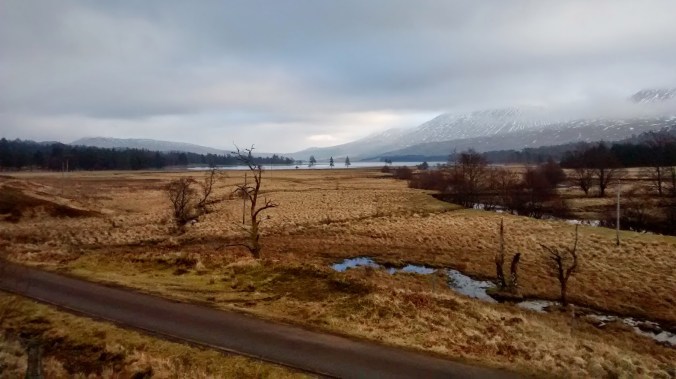
Under a full cover of snow anything short of a fat bike would probably be defeated but fortunately we have caught the weather at just the right time, a slight thaw has stripped the snow from below about 550m and most of the approach is clear although a hard frost has left the ground well frozen. The landcover track follows the northern shore of the Loch Etrict closely, the sky is dull grey and overcast and the waters a cold unfriendly blue. To the south the northern ramparts of Creag Dhubh fall steeply into the loch, lonely and steep looking icefalls cascade down the crags so remote I doubt they see one visitor a year.

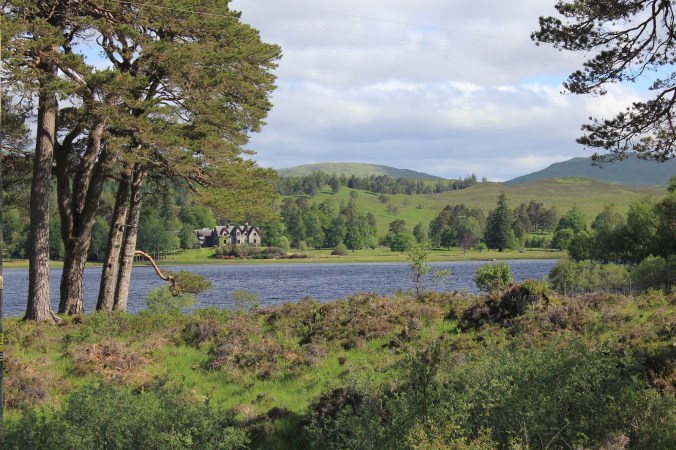
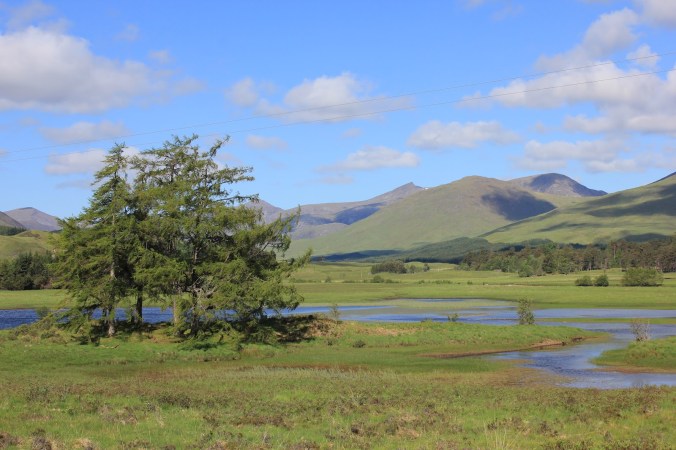
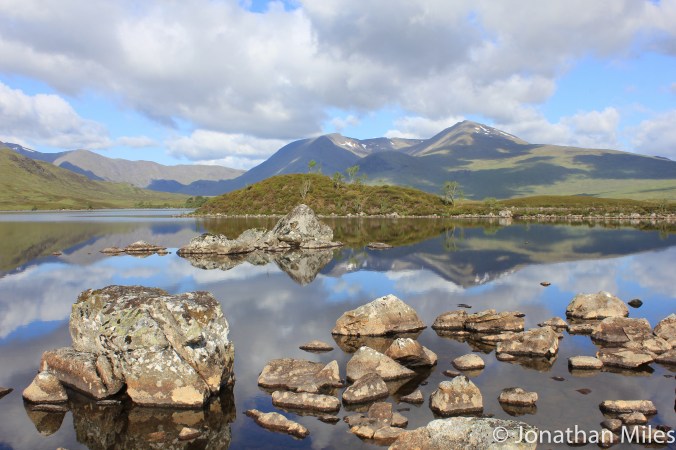
Loch Pattack from the estate track, the path leads right from this point.
Cycling with heavy packs is not as hard as I expected or perhaps its all those miles on the road bike commuting to work through winter that have desensitised me to the effort. The first seven or eight km beside the loch are relatively level and its not until the track turns north at Ben Alder Lodge a faux baronial chateau built to service the super rich that the real climbing up to remote Loch Pattack begins. Even this is not too steep and my legs tap out a good tempo as we leave the trees behind and emerge into the open hanging valley which sits above the lodge.
It is possible to reach the bothy by following the landrover track all the way but where it passes the southern shores of Loch Pattack it is often underwater even in summer and if not a deep ford or wobbly cable bridge must be navigated on the bike. A much better alternative is to take a right down a good path a couple of hundred meters after were the track levels out and the loch first comes into view. This path would be difficult to find under snow but today its firm and disappears easily under the wheels of a bike as Ben Alder and the Leachas ridges slowly come into view.
Just before we reach Culra the path crosses the Allt a’ Chaoil-reidhe which is flowing quickly with little sign of ice, a testament to the past few days rising temperatures. Arriving at the bothy its covered in warning signs and beginning to look a bit sorry for itself coverd in warnings not to enter. However tempting the shelter is we take note and hide the bikes and change outside in the wind into our winter gear.
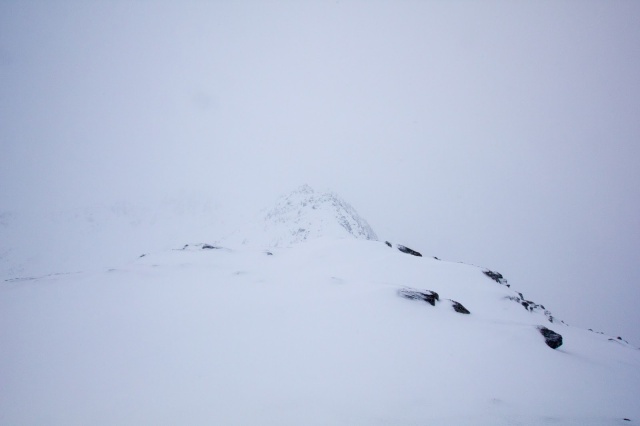
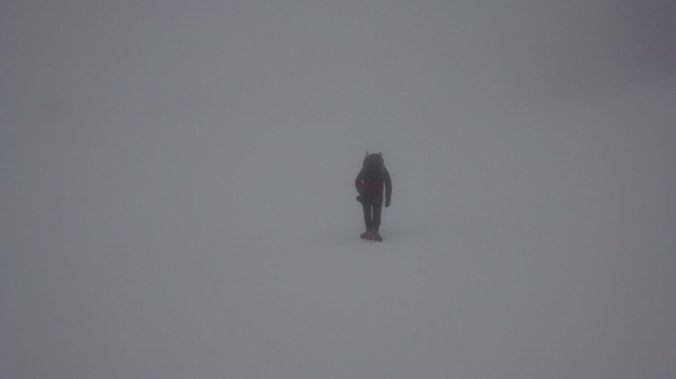
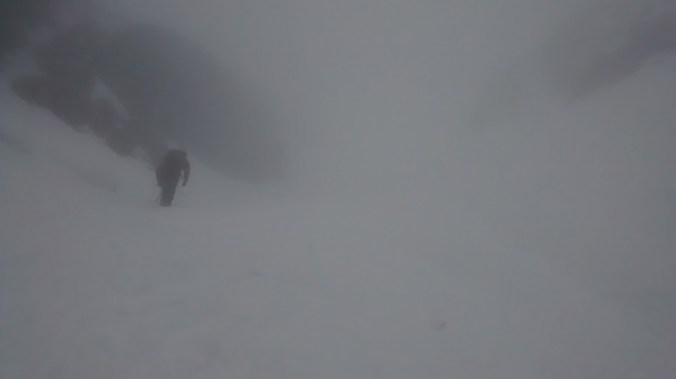
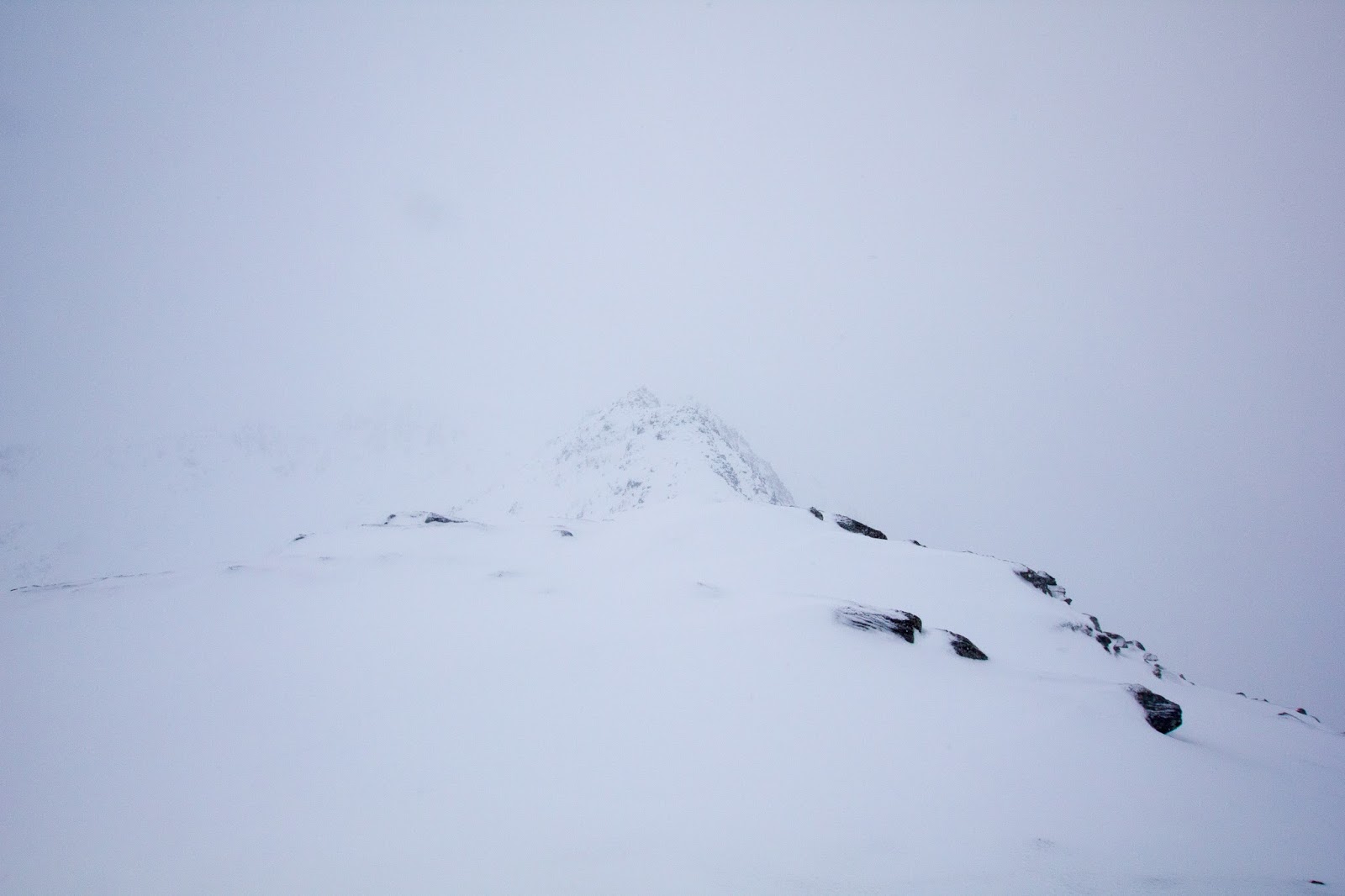
Looking up a very snowy Long Leachas in full white out conditions.
Following the path along the river the snow is generally well packed and the going easy, this changes as soon as we gingerly cross onto the southern side just after the junction with the Allt a’ Bhealaich Bheithe. There is no bridge or neat stepping stones and you have to make use of what rocks come your way; slipping over here would certainly not be a good plan.
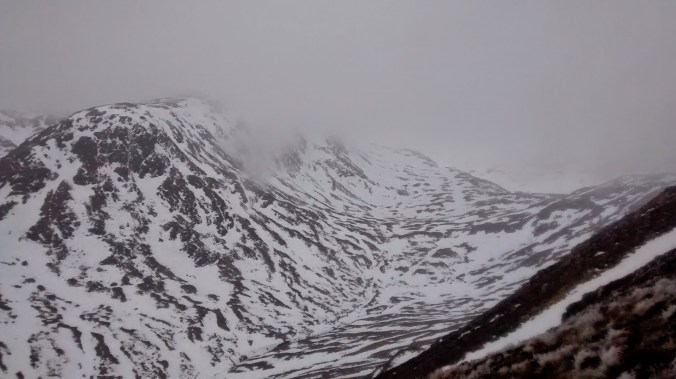
The ridge itself is lost in the cloud above us but the spur on which is sits is an obvious landmark to aim for. The snow morphs from firm neve blasted hard by the wind upon which the crampons bite greedy to deep powder in which they wallow seeking purchase. It’s a pattern which alternates back and forth in a random patchwork across the hillside driven by the subtle differences in the texture of the landscape as it dances with the wind.
Generally its possible to weave the firmer sections together until we find ourselves on the ridge at which point it becomes obvious that the wind has deposited large amounts of powder for us to post hole through. At least the navigation is easy, if you fall off you are not on the route; however the ridge line is generally rounded until it narrows in its upper section with a number of steep rocky steps most buried by snow.

The narrower upper section of the Long Leachas as we timed our arrival at the top with the parting of the clouds.
From the top of the ridge where it meets the shoulder of the mountain its a good 1.5 kilometres and 150m of accent to the summit which would certainly would have been challenging to find if the cloud had not lifted just as we arrived. Marching south before swinging to the south east we are careful not to stray too close to the eastern face of the mountain which falls almost sheer for 300m and must be heavily corniced.
A chill wind continues to push the clouds out the way giving flashes of blue sky and sending sunlight dappling across the snow bound plateau. As it clears the landscape offers up glimpses of neighbouring peaks which drift in and out of view like great ships lost in banks of fog. It takes much longer to reach the summit than expected even though we can see virtually throughout only slowly drawing in such is the scale of Ben Alder’s plateau.
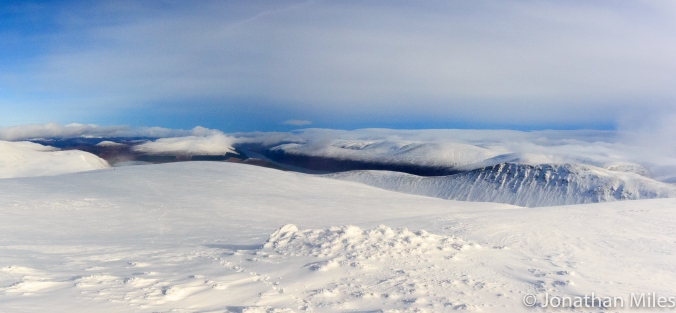
Looking east toward loch Etrict and our start point almost almost out of view at the head of the Loch.
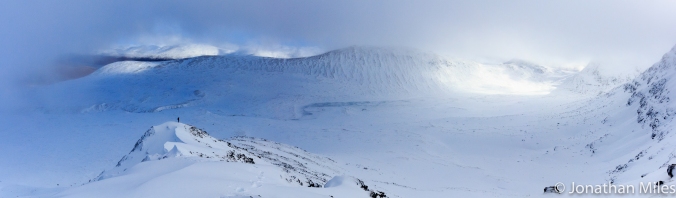
Losing hight on the Short Leachas with a frozen Loch na Bhealaich Bheithe with the munro of Benn Bheoil behind.
Retracing our steps we reach the top of our decent route the slightly shorter version of the Long Leachas which is helpfully called the Short Leachas just in case you get the two muckstip. We had caught a fleeting glimpse of it on the way up, a perfect alpine esque ridge through a window in the thinning cloud. Now with the clouds lifted it’s revealed in its glory as a delicate snow aerate weaving its way down the mountain in a series of delicate cornices.
With a bit of care its a joy to descend, the view in front opens out giving a stunning panorama over a frozen Loch na Bhealaich Bheithe with the munro of Benn Bheoil behind. There is a huge sense of space as if one is decending into a void with the vast eastern face of Ben Alder stretching away to the left and right as you walk down this narrow line of white suspended in the sky. Sunbeams breaking through the clouds catch the gullies, ridges, and faces of the surrounding peaks causing them to glow with transient glory before the door closes and the light moves on.
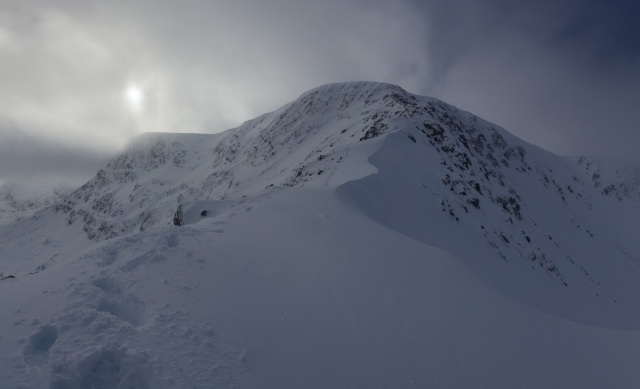
Looking back up the corniced ridge of the Short Leachas, certainly the highlight of the trip and great value for the grade in these conditions.

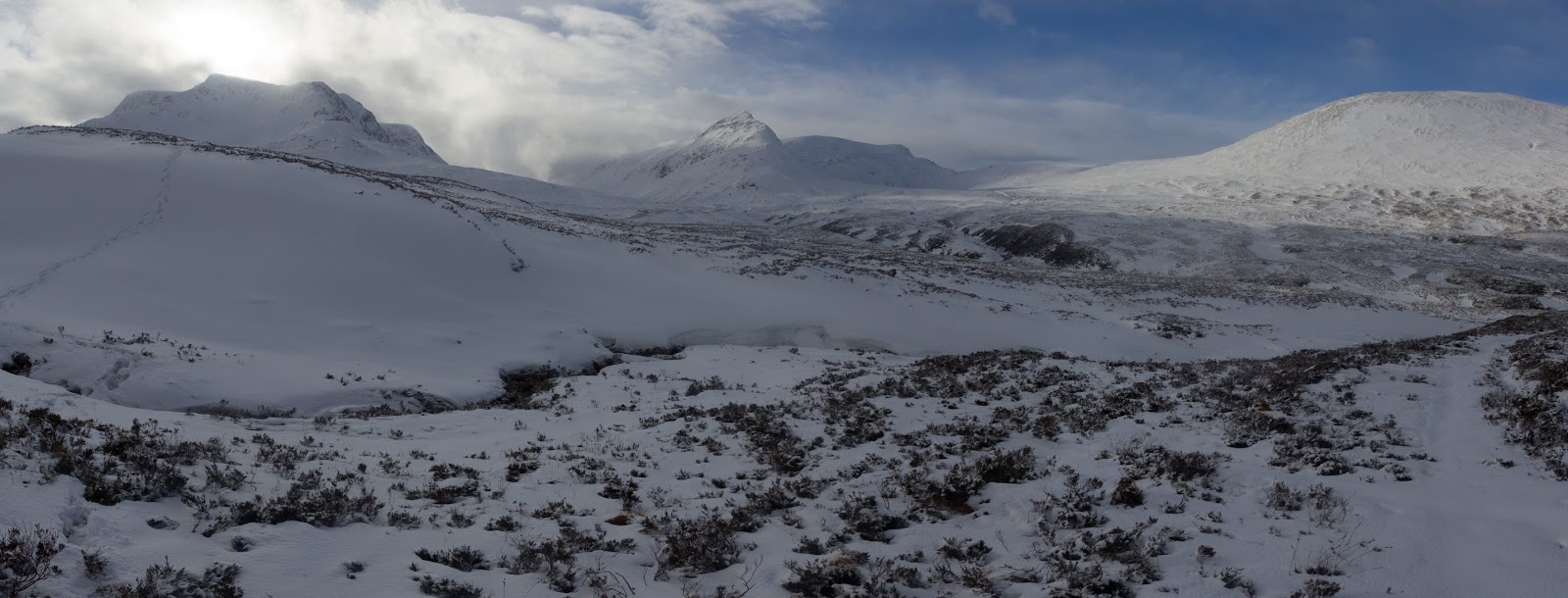
Reasons to return; Ben Alder and its ridges (left) and the equally brilliant Sgor Iuthan (centre) with Geal Charn behind and the rounded Carn Dearg (right)
Having descended from the airy beauty of the ridge its a bit of a shock to be back on the flat with a long snow slog back to the bikes; although gently downhill the miles in soft snow are beginning to tell in the legs and there is another river crossing to deal with to get across the Allt na Bhealaich Bheithe. Following the river for a while we find a crossing point after about fifteen minutes, carefully stepping from rock to rock as the ice cold water tumbles between them.
At the bikes the last of the coffee is drained from the flask before crampons, boots, and axes go back in the bag with the heavy winter waterproofs, to be replaced by lightweight cycling shoes (perhaps not the best choice). Before leaving its compelling to take one last look at Ben Alder, already three kilometres away it sits majestic as the sun begins to slowly hide below its summit; the eye is also drawn to its neighbour Sgor Iuthan and an equally fantastic looking ridge with descends from its summit.
Temperatures have risen during the day and the ground has started to thaw so the wheels don’t roll as easily as they did this morning but my 29er excels on this type of terrain, fast and smooth particularly when back on the estate road. Even with 40 plus kilometres in the legs I feel full of energy from the satisfaction of the day; a proper alpine experience in the UK and the feeling that we have had to really work for what we achieved. More importantly I feel we did one of the great mountains of Scotland justice. I will certainly return to this remote spot, the challenge of getting here makes the experience all the more rewarding.


 Boots, Boats, and Bikes