“Believe me, my young friend, there is nothing – absolutely nothing – half so much worth doing as simply messing about in boats.” These words from Rat to Mole in the Wind in the Willows, invoke the joys, beauty and adventure of days on the water, invoking motifs and memories, the gentle rocking of the boat, sunlight glinting off the water, or the long branches of the weeping willow swaying lazily in the breeze.
The Edwardian idle of Ratty and Mole lounging on a riverbank may never have existed even when the words were set to paper; indeed as my packraft lurches over yet another wave the Wind in the Willow-esque dream I had imagined for todays tip on water could not be much further from the reality.
So why did I find myself in the middle of a boisterous Ullswater lake in what, wishful thinking on my part would describe as a packraft, but in reality could be more accurately described as a dinghy!
So to rewind, the idea for this trip had grown out of various ideas to have an adventure that allowed me to see the Lake District from a new angle, away from the crowds, and also with a real feeling of pushing myself to try something new. So with maps spread out on the floor at home my finger trying to trace rivers, lakes, and tracks I came up with the plan; a traverse north to south down the length of Ullswater and Windermere with a wild camp on the hills hiking in between the two sections of paddling. I had visions of lazy summers days on the lakes, exploring the islands which dot their surface, a proper adventure.
I’ve owned a kayak for many years, but its a big lump of plastic that is the antithesis of the words light and flexible, I really struggled to see how I could use it in a practical way, and certainly did not want to carry it over any hills! Fortunately new outdoor toys are appearing to fill problematic niches such as this, what I needed was a packraft.
Small inflatable boats, packrafts are a long way from kayaks; virtually the only similarity they share is they work on water and you move them about with a paddle. The first packfrafts originated to help troops cross rivers in the mid 20th century, but the boats we know today really came out of Alsaka much more recently. Developed to help people move through the mountain and dense forest that makes up much of the state; they are light enough to be carried in a rucksack but durable and sturdy enough to run the white water.
It seemed the perfect solution, supreme flexibility of movement, easily capable of taking a person, sack, and even a bike over river and lake, quickly linking together points on a map that would otherwise be a challenge. For Scotland, Scandenavia, indeed anyplace that is a land rich in water they look great, I knew I wanted one, and then I saw the price and knew I had a problem!
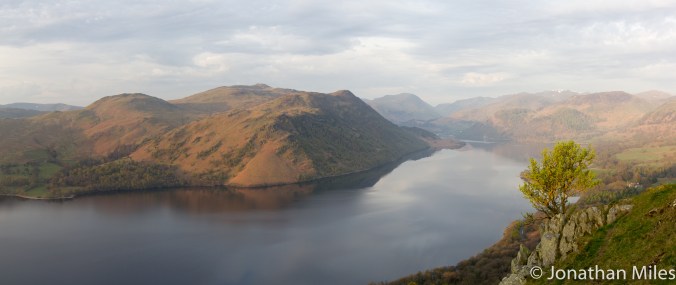
A Still Looking Ullswater at Dawn
So this is why I’m currently paddling along the length of Ullswater in a £30 dinghy rather than a £1,000 packraft; as this first trip is on flat water and I’ve convinced myself I’ve no need for a white water capable craft, which is good as currently neither does my bank balance.
The weather dealt the first blow to my well laid plans, the forecast was for a dry still weekend but unfortunately the high pressure system bringing these benign conditions must have been delayed, because when I launched from Pooley Bridge on Saturday I found myself paddling into a headwind strong enough to cause the yachts on the lake to slew round their moorings, their flags and pennants streaming out in the breeze.
I had chosen to paddle within 30 or so meters of the bank just in case I had an issue with the raft and needed to beach it quickly! I lashed my rucksack to the grab-line round the craft to prevent any accidental offerings to the lake and further stuffed it with two inflated airbags taken from my kayak just in case.
In the teeth of the wind any forward movement was heavy work and progress felt hard won, staring at the bank I would watch as I ever so slowly caught and overhauled trees and rocks, after about two hours I pulled into the bank for a rest and made the dispiriting discovery I had covered only about two kilometres.
Ullswater looks very different on the lake itself, from the banks you only see one aspect, a neat perspective of the water and shore leading the eye out into the lake. From high in the the hills you get a different view, how the lake fits in the landscape, the curve of the bays, and bumps and spurs of promontories or dog legs. From the middle of the lake the biggest feeling from the landscape is a sence of space, stretching out in all directions, distances become hard to judge as promontories overlap with each other foreshortening perspectives. The shape of the lake is also hidden, bays and even the large dog leg half way down the lake only revealing themselves at the last moment sliding into view from behind hills and trees.
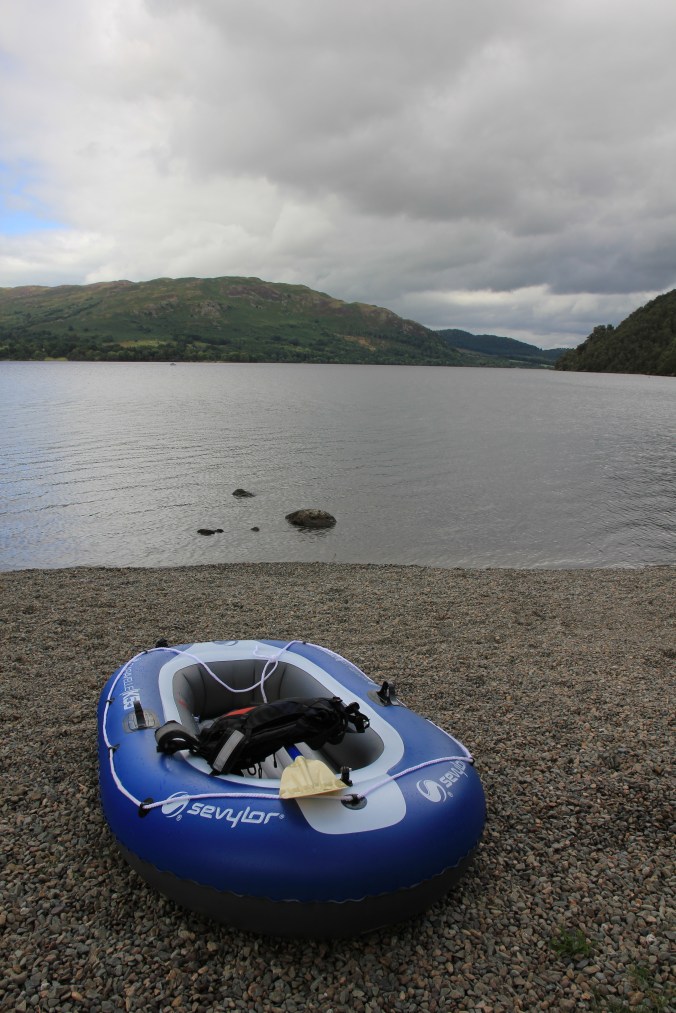
£30 of High Performance Packraft
At about the half way point I had to be bold, to reach my campsite I needed to cross the lake, moving out from the safety of the shore over about 600m of open water which at my current pace could take me at least three quarters of an hour. In still air this would have been fine, but the windy conditions had whipped the waters out from shore in to a decent swell which the though of battling far from the safety of the bank I found unsettling.
With my pulse slightly raised I concentrated on paddling efficiently with good strokes on both sides to make progress as quick as possible, attention focused on a rocky buttress on the far side of the lake. Once out of the protection of the shore the wind seamed to pick up and the waves increase, I had to take them head on but the raft coped better than I had expected although I did ship a bit of water from splashes that required bailing out (proper packrafts come with spraydecks). When I reached the far side I landed on a tiny beach for an obligatory large mug of Yorkshire Tea and biscuits feeling particularly heroic!
After six hours of hard work and having covered a mere 10km I arrived on the small beach at Silver Bay, I had spotted the location earlier in the year and marked it out as an excellent camping spot, a thin strip of grass lying between the gravel and thick bracken. The paddling had been so hard but also very rewarding, I felt I had made a real effort to make those 10K and managed to deal with what the weather had thrown at me. I did however realise I had bitten off more than I could chew for a first trip and I had made the decision paddling Windermere tomorrow was not on the cards .
By the time the tent was up (and more tea brewed!) the wind had begun to drop, leaving just a few ripples on the surface of the lake and a beautifully still evening as the last few boats headed in to their morings for the night. Although Ullswater is a busy lake Silver Bay feels secluded and I was able to go for a cheeky, if also slightly chilly wild swim au-naturel without the fear of being overlooked.
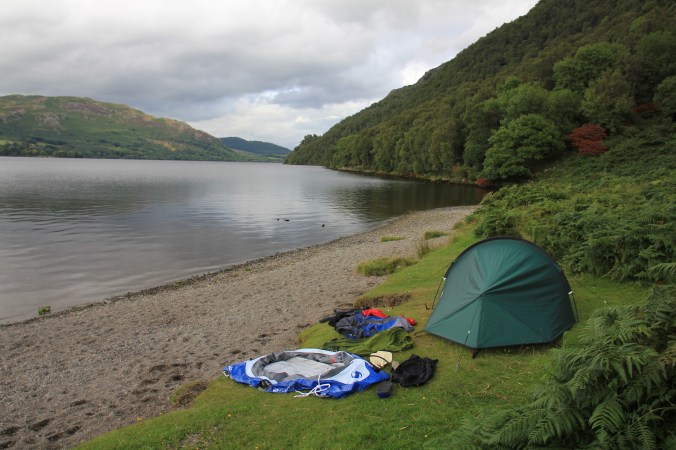
Camping at Silver Bay
Settled conditions had certainly arrived by Sunday as I took the tent down in the still morning air. Raft deflated and packed, buoyancy aid stowed, and paddle disassembled it was time to validate the first half of the packraft concept. Proper rafts weigh about 2.2kg, obviously for £30 mine weighed about half as much again but my pack was not uncomfortably heavy and certainly manageable for multi-day trips.
My walking route took me up Heart Fell by the Hartsop ridge, the original plan, now discarded in favour of a more sane option had been to descend from here to Ambleside and paddle the length of Windermere. Instead I now followed the ridge line round to Red Screes before descending down to the Kirkstone pass and a well deserved beer before catching the bus back to Pooley Bridge.
I will certainly return to packrafting although probably in something a little more rugged next time. There is a lot of possibility for real adventures, new approaches to the hills such as Slioch across Loch Maree, or the Munros down Loch Etive in Scotland; even in busy England its a great way to explore the Lakes, the Broads, or the Thames; for those with white water skills they offer even more flexibility. Just being on the water makes any trip to the hills a little bit more adventurous, because deep down we all think a little bit like the Mole.
“Never in his life had he seen a river before—this sleek, sinuous, full-bodied animal, chasing and chuckling, gripping things with a gurgle and leaving them with a laugh, to fling itself on fresh playmates that shook themselves free, and were caught and held again. All was a-shake and a-shiver—glints and gleams and sparkles, rustle and swirl, chatter and bubble. The Mole was bewitched, entranced, fascinated.”
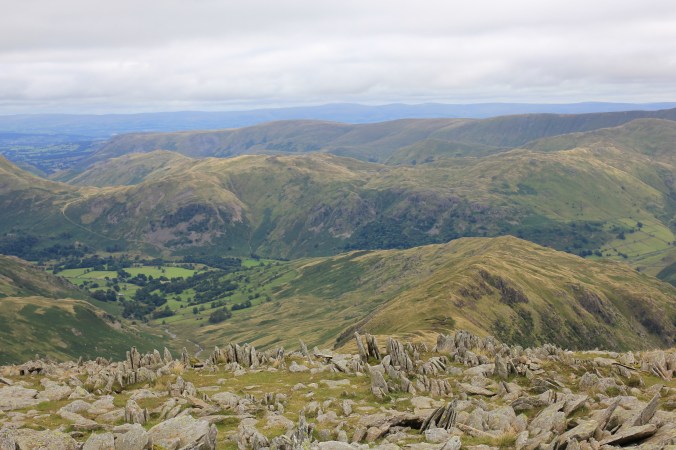
Looking Down Hartsop on How from Heart Fell
 Boots, Boats, and Bikes